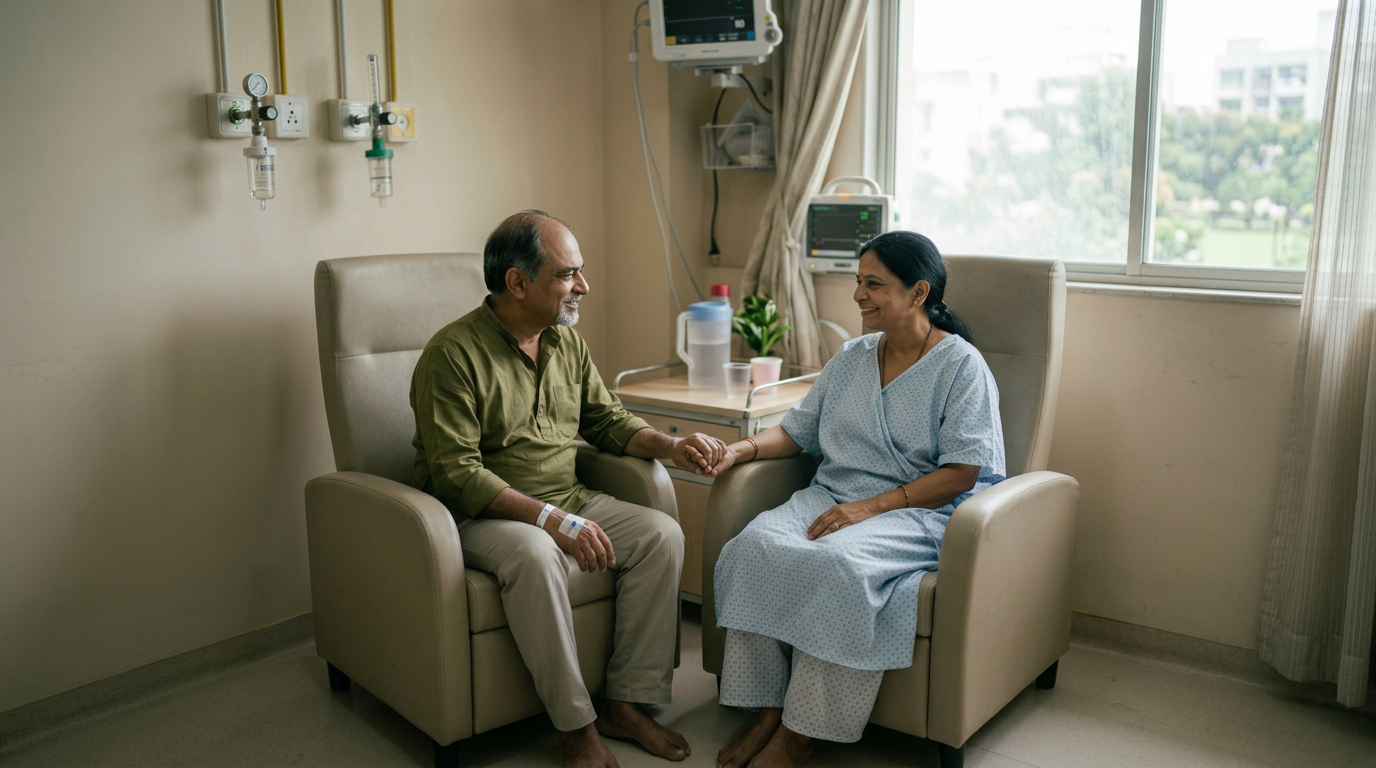
Throughout my cancer story, and the other stories I have shared with the world, Harsha’s name has popped up often. Who was Harsha? She was my wife.
But what I haven’t shared is who she was as a person, before illness took over and changed the persona of a very decent human being.
I met Harsha on the 28th of March 1979. That alone is a different story. My marriage was arranged and our meeting organised by mutual family members. We got married on the 6th of October that same year. And our journey that would last forty years began.
Harsha was a happy-go-lucky person. Bubbly, affable, very quick to make friends, and an entertainer — both dancing and dinner parties. She loved life and people. She loved children, and that shows in our two, Mitesh and Rakhi. Harsha was a choreographer and created many dance routines from Bollywood film songs, which she presented at our community’s annual programmes. She also took part in some of her own creations. She loved cooking and inviting family and friends over, where there was sure to be a feast.
My brother remembers her this way: “Someone that would feed you with all her heart and even then, it wasn’t enough. The centre of any gathering. Positive, loving, caring and giving. Loud — getting excited and happy. Dedicated to family and friends. Inspiring and creative. She loved her music, her kids, her grandkids. Someone I have fond memories of. This is just a snippet. Miss her always.”
He said it better than I could. And he only had a snippet. That is who she was. That is who I was fighting to come home to.
What went wrong.
She had a mini-stroke in 2004. Initially diagnosed as a TIA, where her recovery would be quick. But it wasn’t so. The stroke had created a lesion on the front temporal lobe, which caused memory issues and partial complex seizures. This went undiagnosed for a long time. It was only during a brain scan that two lesions were discovered — probably caused by the seizures, which had also gone undiagnosed. This set the grounds for what was to follow in our lives.
Fast forward to April 2007. I had a confirmed diagnosis of Hodgkin’s Lymphoma, and my treatment was to start on the 17th April, beginning with chemotherapy.
But Harsha hadn’t been told. She was herself an inpatient at the same hospital. Maybe God had helped me — getting her looked after in the ward while my own diagnosis was in progress. I don’t know how I would have coped if she had been at home, with no care plan in place.
After my first chemotherapy session — which was, ironically, in the ward next door to hers — Harsha kept wondering why I kept going there for meetings with the doctor and nurses. I had made excuses that we were discussing her treatment.
But this couldn’t carry on. Harsha needed to be told whilst she was still in hospital, so we could be there to help her through whatever came next.
The nurse brought Harsha into a private room. She sat down, the nurse holding both her hands. The worried look on Harsha’s face pained me. Bemused, she looked at the nurse and the doctor, then at me. She mumbled something — “what’s wrong?”
The nurse began by telling her about my diagnosis.
Harsha’s jaw dropped. Mouth wide open, quivering lips, and almost a tear coming down her face. She was shaking. She said: “No. Not my Dad.” That’s what she called me.
I could see the panic in her eyes. What’s going to happen to me if Dad dies — she must have thought it, even if she couldn’t say it.
The nurse was very good. She calmed Harsha down, still holding her hands, giving a squeeze every now and then. She explained everything — the type of cancer, the chances of survival, the treatment plan. There was a huge sigh of relief at the very optimistic news. I think the doctor and the nurse breathed a sigh of relief themselves, having navigated the situation to a good conclusion. Harsha had calmed down. She was drinking a sweet cup of tea, relief clearly showing on her face and in her eyes.
Then the nurse and doctor gave us some personal space.
We kept staring at each other, trying to read what the other was thinking. But the look and the damp eyes said it all.
Finally, I got up from the armchair. I went to her, held her hand, and stood her up — so I could give her the longest hug possible.
This is Part 5 of My Cancer Story. Read the full series here.
If you or someone you know has been affected by cancer, Macmillan Cancer Support and Cancer Research UK offer information, support and helplines.

Leave a Reply