On Thursday, 16 July, my friend and I took the train to Stratford-upon-Avon. I had been looking forward to the trip. I enjoy literature, and who has not heard of Shakespeare? But I also had a quiet worry that it might be a damp squib — just a normal town with old buildings, trading only on its famous past.
We left from Marylebone, changed at Leamington Spa, and arrived at about 3.45 pm. The journey took about two and a half hours with frequent stops, but I do not mind trains. They avoid the traffic, and there is something about watching the countryside pass that settles me.
We checked into our hotel, which we had deliberately chosen to be close to the town centre, freshened up, and went exploring. Almost everything closed at around 5 pm, so the first evening was mainly about getting the feel of the place and working out how to make the most of Friday.
My first impression was promising. The town felt compact, walkable, and full of hints that Shakespeare’s presence still shaped the streets around it. I was relieved. This was not a theme park. It felt like a real place that happened to hold an extraordinary history.
On Friday, after a hearty breakfast, we made our way to the Shakespeare Visitor Centre. You could book tickets there for three attractions linked to Shakespeare. The centre itself had an exhibition — two rooms showing videos with quotes from his works, and displays of the clothing, money, pottery, paintings, and notebooks from his time. The exit led along a garden path to the house.
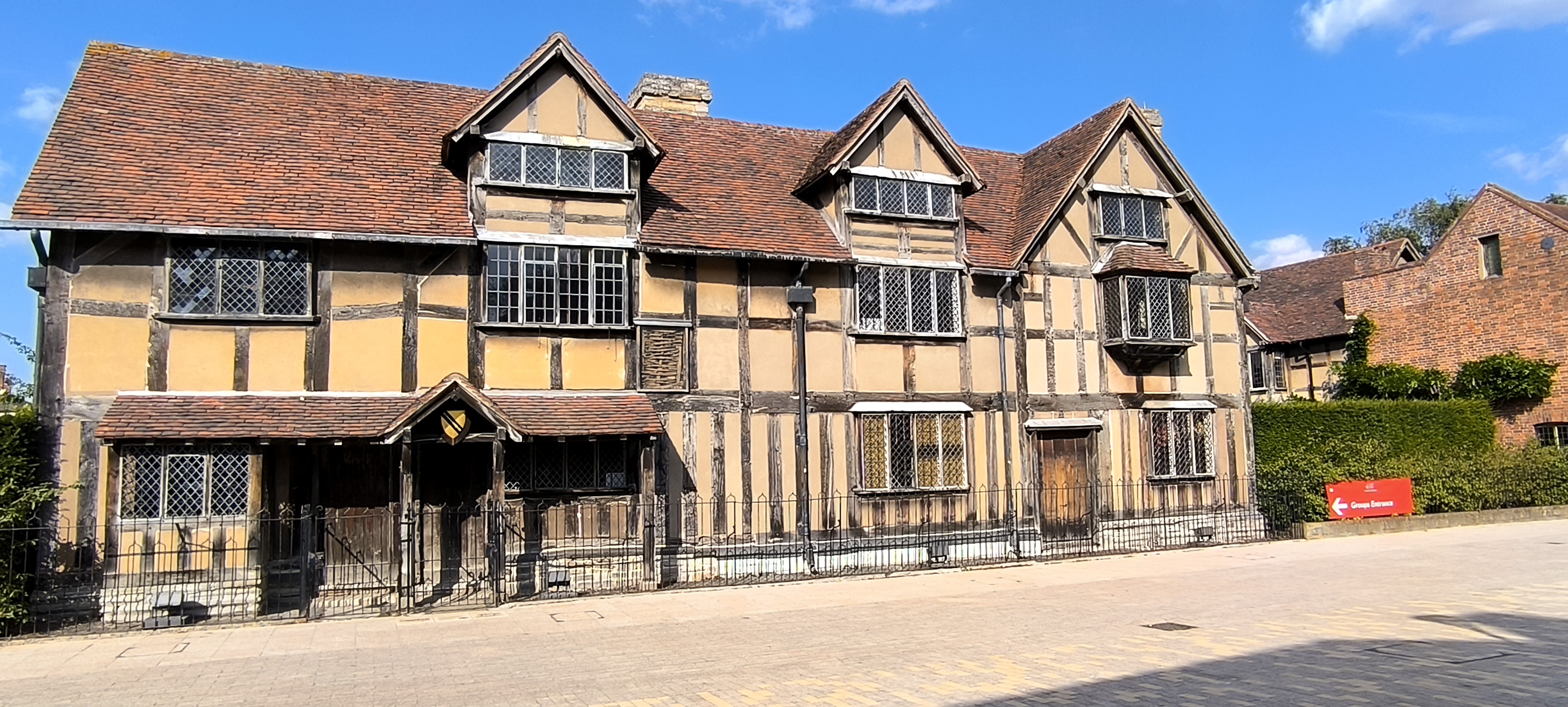
Shakespeare’s birthplace stands on Henley Street. It is a sixteenth-century, half-timbered building, made with a wooden frame and materials like wattle and daub, stone, and timber. This is believed to be the house where William Shakespeare was born in 1564 and where he spent his childhood. His father, John Shakespeare, lived and worked there as a glove-maker and wool dealer, so it was both a family home and a place of business. As we walked through the rooms, that became easier to understand. There were domestic rooms showing how the family may have lived, and a workshop area connected to his father’s trade.
What I found fascinating was the history of the house itself. After John Shakespeare died, William inherited the property, though by then he had moved elsewhere in Stratford. The house later passed through the Shakespeare and Hart families and was even used as an inn before it was bought and preserved in the nineteenth century after a public campaign. Walking through the low rooms and seeing the period furnishings made the history feel real, not just something written in a book.
The exit led through a gift and book shop. Everything was Shakespeare and Stratford. My favourites, of course, were the books.
Exploring Stratford-upon-Avon
Next on our list was New Place.
This is the site of the grand family home Shakespeare bought in 1597 when he became successful. He bought it for his wife and daughters, who lived there permanently, while he spent much of his time working in London. He returned for longer periods over the years and retired there completely around 1611. I had not known any of this before arriving in Stratford-upon-Avon.
But the house is gone. It was demolished in 1759 by a later owner, a Reverend Francis Gastrell. One of the guides told us the story, and I found it extraordinary. The Reverend was apparently so annoyed by tourists peering into his garden to see Shakespeare’s mulberry tree, and so angry about paying tax on the property, that he razed the whole thing to the ground. I stood there thinking what a loss that was. I would have loved to see how it looked inside, how they lived. Instead, the footprint of the building is outlined in bronze on the ground to show its original scale. It was disappointing, but knowing the reason made it memorable.
What was not disappointing were the gardens. I walked the entire path with my friend, though he was not especially interested in the literary meanings behind the sculptures. I was. I had to stop at each one, because there was a story behind every piece. Some of them did not look as though they had any particular features at first glance, but I was wrong. They were very intricately made. Amazing artwork, quietly placed, waiting for someone to look properly.
Exploring Stratford-upon-Avon
After New Place, we walked to Anne Hathaway’s Cottage in the hamlet of Shottery, about thirty minutes on foot from Stratford-upon-Avon town centre. Even from the roadside, it was not disappointing. We stopped at the coffee shop opposite for tea and cake before going in, which felt like the right way to approach a house that has been standing for over five hundred years.
The idea of entering a building that old is what amazed me most. From the outside it looked substantial, but inside it was surprisingly small. I understand that rooms were added over the years, and the restorations had been tastefully and carefully done to reflect the period. Upstairs, steep and creaky wooden steps led us to the bedrooms, and to a room with a desk and chair from that era. On the desk were manuscripts, letters, and pieces of paper, all preserved to reflect the importance of not only Shakespeare himself but also the part Anne Hathaway played in his life. It was one of those moments where you stop thinking about history as something distant and start feeling it as something that happened in a room not much bigger than your own.
By the time we left, we had walked a great deal. We called an Uber back to the hotel for a well-deserved rest. Later that evening, we went back into town for a traditional fish and chips at a place called The Chip Shed, which did not disappoint. After that, we retired to the hotel. Saturday was planned for Warwick Castle, and we needed the rest.

Leave a Reply