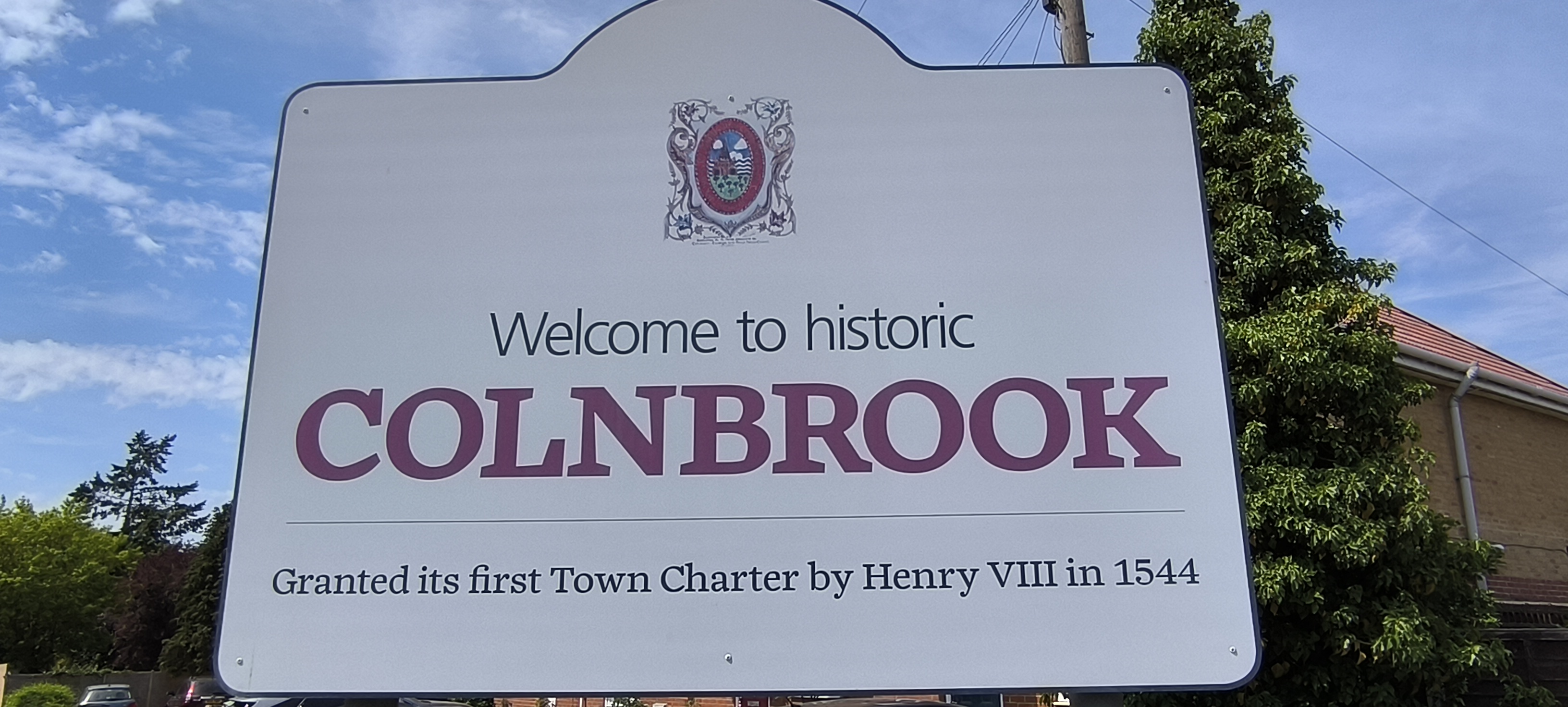
“This is the first in a new series called Walking It Off — a Colnbrook village history walk that changed how I see home. Murder, ghosts, royalty, and my wife’s old pub, all within half a mile of my front door.”
I have lived in Colnbrook for more than three decades. I have driven through it, walked to the corner shop, nodded at neighbours, and thought I knew the place. It took a pandemic to prove me wrong.
In 2021, Covid stopped everything. When I recovered, I did what a lot of people did — I rediscovered my feet. Instead of driving somewhere worthy, some National Trust car park an hour away, I decided to see what was actually on my own doorstep. So one quiet afternoon in 2022, I pulled on my shoes and walked out of the front door with no particular plan. Just Colnbrook. On foot. Properly, for the first time.
What I found astonished me.
A Colnbrook Village History Walk Begins Here
Walking down the High Street, it is remarkably peaceful. But you are walking on the Old Bath Road — once the premier highway connecting London to the West Country. Because Colnbrook sat exactly one day’s travel from London, about 17 miles, it became the ultimate stopping point. In 1577, this tiny stretch had ten coaching inns serving travellers, royal carriages, and heavy turnpike wagons. The village only kept its narrow, medieval character because a bypass was built in 1929, freezing the High Street in time.
Standing on that street, I noticed something I must have driven past a hundred times without ever registering. Right opposite the Ostrich Inn, the old 17th-mile stone still stands. I stopped and took a photograph. It is just a stone, but it felt like a doorway into something. I wanted to know more.
Murder, Ghosts, and Royalty
Colnbrook with Poyle has 36 listed buildings, and their stories are extraordinary.
The Ostrich Inn is the crown jewel. Founded in 1106, it is the third oldest pub in the UK — and one of the darkest. In the 17th century, a landlord named Jarman built a mechanical trapdoor in the Blue Room. Wealthy guests would be tipped through it into a boiling cauldron in the kitchen below. His final victim, a man named Thomas Cole, is said to still wander the corridors. I have been in the Ostrich since that walk. Knowing what I now know, I looked at it rather differently.
Just down the road, Ye Olde George Inn carries its own royal history. In 1555, Princess Elizabeth — not yet queen — stayed here as a prisoner while being moved to Hampton Court. And tucked between the George and the Ostrich, almost invisible unless you know it is there, is a Methodist church accessed through a tiny entrance off the High Street. Faith and ale, side by side for centuries. Colnbrook has always made room for both.
The Star and Garter
This is the part of the walk that stayed with me longest.
The Star and Garter on Park Street closed in 2015 after decades as a cosy, busy local. It sat empty for roughly twelve years before being converted into residential apartments. The car park is still being built over as I write this. But the facade remains exactly as it was. The old pub sign is still there. From the outside, it looks like it could open tomorrow.
My wife Harsha was the chef there from around 2001 to 2004. It was a tiny pub inside — you would not believe how small — but it served as a proper local for the villagers. The landlord was a man called John, a local Tory of some description. The barmaid was a woman called Sue, whose husband was one of my customers when I worked at British Airways. I still bump into him occasionally.
Standing outside the Star and Garter on that 2022 walk, knowing Harsha had cooked in that kitchen, knowing her health had taken over not long after she left — it was a strange feeling. The building preserved perfectly on the outside, changed completely within. I know how that feels.
What I did not realise until I looked it up later is that King John’s Palace — a c.1600 manor — is directly attached to the Star and Garter. Harsha was cooking next door to a medieval palace. She never mentioned it. I doubt she knew.
Just yards away, the Colne Brook runs quietly under a small bridge — one of the two streams that give the village its name. It is easy to miss if you are driving. On foot you stop, look down, and wonder how many thousands of people have crossed this same point over the centuries. It is moments like this that make a Colnbrook village history walk worth doing slowly.
The Small Details
Walking a little further, you encounter the kind of things that only reveal themselves on foot. A house called Toad Hall with a tiny door that looks built for someone considerably shorter than the rest of us. Nearby, Black Boys Cottage and White Cottage stand almost side by side — two names, two histories, quietly facing each other across the years.
St Thomas’s Church
Set back from the bustle of the High Street, St Thomas’s Church was consecrated in 1852 — the year Colnbrook finally became a parish in its own right, no longer dependent on clergy from neighbouring villages. It is Grade II Listed, built in a quiet location that is now, less quietly, surrounded by a housing estate. The old world hemmed in by the new. You see that a lot in Colnbrook.
I have been inside twice. Once for a coffee morning, which was warm and welcoming in the way only village church coffee mornings can be. And once for the funeral of a neighbour — the local Colnbrook and Poyle secretary for many years. A man who served his community and was buried in his community’s church. There was something right about that.
What draws me back, though, is the churchyard. I have a passion for old gravestones — reading the names, the dates, the small inscriptions that are all that remain of a life. The older the stone, the better. There is something about standing in front of a gravestone from two or three centuries ago and realising that this person walked the same High Street, crossed the same bridge over the Colne Brook, perhaps even stopped at the Ostrich for a drink. We are not so different. We are just further apart in time.
A Village That Has Changed
The demography of Colnbrook has shifted dramatically in recent years, largely because of its proximity to Heathrow. Many of the original villagers have left or passed away. The local postmaster, who served Colnbrook for more than thirty years, is gone. The connections that held the village together are looser now, and some have gone altogether.
That is not unique to Colnbrook. It happens everywhere. But it feels more noticeable in a small place, where you could once name most of the faces on the High Street.
The Walk I Still Do
That first Colnbrook village history walk opened my eyes to what I had been missing. I found a shortcut that leads to the Colnbrook Bypass, from where you can walk out to Harmondsworth Moor. I still do that walk every couple of weeks. Sometimes I listen to music. Sometimes an audiobook or a podcast. Sometimes nothing at all. It clears my head, gives me perspective on whatever is weighing on me, and reminds me that I am lucky to have it on my doorstep.
I started walking alone in 2022. For a couple of years it was just me. Then an old friend got back in touch — he wanted the same thing, a regular walk, fresh air, somewhere to think. Now we go together sometimes.
If you have lived here for years and never walked the High Street properly, do it. Not as a tourist. Just as someone who lives here and wants to know where they actually are. You might be surprised by what you find.
I certainly was.


Leave a Reply