On Saturday morning, after a breakfast big enough to last the day, my friend Jessie and I caught the X18 bus to spend the day at Warwick Castle in Warwick.. Schools had broken up for the summer the day before, so we knew it would be busy. Our plan was to get there early. When we arrived, the queue was already long, but it was moving.
We had booked tickets online, which saved both money and time. The bus dropped us opposite Castle Lane, and from there it was a short walk through the car park to the entrance. On either side of the arched entranceway, large maps showed the scale of what lay ahead. This was not going to be a quick visit.
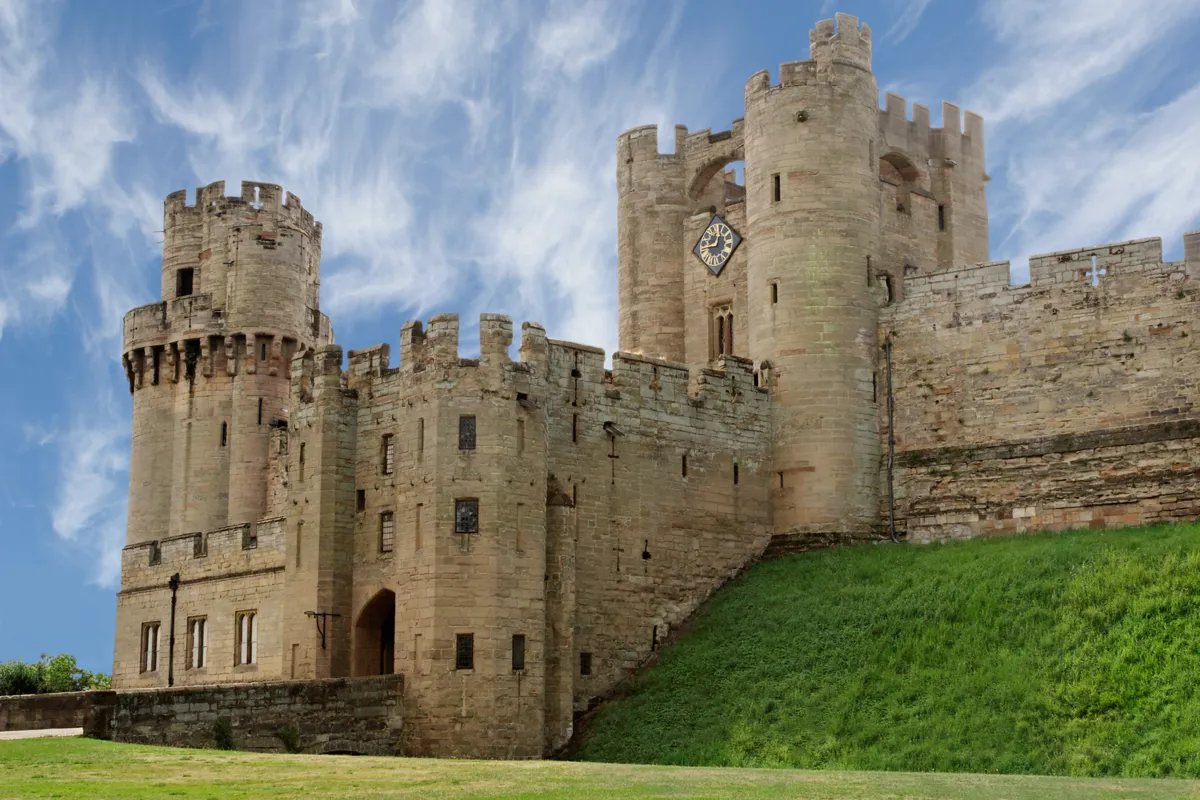
And it did not disappoint. The circular tower was the first thing I saw, looming high into the sky. A bridge led to the castle entrance, and above the huge doorway there was a clock and a portcullis-style gate. I could immediately picture how it would have been lowered to keep enemies at bay. That is what old castles do to me — they make my imagination fill in what the stone no longer shows.
Warwick Castle has stood in some form for over a thousand years. It began as an Anglo-Saxon fortification in 914, was rebuilt as a Norman fortress after the Conquest, expanded and fought over through centuries of war, transformed into a grand stately home, and eventually opened to the public in 1978. Walking through it, you feel every one of those layers.
Inside Warwick Castle
We made our way up a stone staircase to the Great Hall, which now serves as the armoury. I could have spent an hour in that room alone. The collection was vast — bows and arrows, spears, lances, knives, swords, long shotguns with bayonets. There were early pistols and what I learned was a precursor to a grenade launcher, which apparently had a tendency to blow up in the holder’s hands. That made them unpopular, unsurprisingly, and examples are now rare. Two life-size display horses stood with figures in full suits of armour. I looked at them and tried to imagine the weight of all that metal on a man’s body. Awesome is a word I do not use often, but the armoury earned it.
From there we moved through the castle’s grand rooms. Each one had something that surprised me. The Cedar Drawing Room, the largest, was originally a ballroom, with panelling from the 1670s. The Green Drawing Room had a ceiling replicated from a Roman temple in Palmyra, Syria — a temple that was destroyed in the 2015 conflict, making this ceiling the only surviving version. That stopped me. A room in an English castle holding the last trace of something ancient from the other side of the world.
But the detail that caught me most was smaller and quieter. In one of the rooms, there were a couple of Japanese dish bowls, beautifully made, which would have been used for guests to wash their hands. The quality of the workmanship was extraordinary. I stood there looking at them, thinking about the hands that had made them and the hands that had used them, centuries apart. It is always the small things that stay with me.
The Queen Anne Bedroom held the bed in which Queen Anne is believed to have died in 1714, adorned with red velvet and gold floral silk. It had been gifted to the castle by King George III. The Blue Boudoir, originally a dressing room, had been converted by Daisy Greville, a socialite turned activist, into her private writing room. It also housed waxwork figures of Henry VIII and his six wives. Every room had its own character, its own story, and we spent more time inside than we had planned.
Eventually we made our way outside. The Time Tower had two rooms showing short films about the castle’s eleven hundred years of history. It was a warm day and the crowds were large, which meant queuing for everything. We stopped for a short lunch break, which turned out to be a mistake — not for me, but for Jessie. He had wanted to see the trebuchet show, and we missed it. Too much time spent inside the castle. I was not sorry about that, but he was.
There was still plenty to see. The War of the Roses live show was next, and the queue had already started forming a good hour before it began. A long wait on our feet, but it was worth it. When the time came, the crowd surged forward across the bridge to River Island. There was a huge arena with stands on both sides. The show lasted about forty-five minutes and was spectacular — trained actors performing jousting, sword fights, and stunts, with fireworks and speakers describing the history of the conflict. The horsemanship was excellent. It felt less like entertainment and more like a window into something real. The story behind the Wars of the Roses is a history book in itself, and I would rather the reader imagined what it must have been like all those hundreds of years ago than have me try to summarise it here.
About half an hour after that, the falconry show began — an endangered species display that was both beautiful and sobering. We stayed for it, and then stayed until Warwick Castle its gates.
By the time we left, we had been there the best part of a full day and it still did not feel long enough. We caught the bus back to Stratford-upon-Avon, had our final meal at the hotel, and packed up for the journey home on Sunday. The train back to Marylebone got us there by mid-afternoon.
Warwick Castle is one of those places that gives you more than you expect. I went hoping for old stone and a bit of history. What I got was a thousand years of it, a room full of weapons that made me glad I live in this century, a Japanese bowl that made me think about craftsmanship and time, and a live battle that made me feel, just for a moment, what it might have been like to stand on that ground when it actually mattered.
I would go back. There is more to see. There always is.