I have visited Leicester many times since I left at the end of 1979, but those trips had always had a reason behind them — a wedding, a birthday, an invitation, or a funeral. I never really felt I was going home. I had arrived in Leicester on 19 June 1972, after being exiled from Uganda, and spent seven years working and living there with my parents and two younger siblings. It became my second hometown after Kampala.
This time was different. On 18 July 2026, I took a coach to spend a couple of days with my younger brother, Jitu. There was no formal occasion pulling me back, no timetable set by someone else, no family duty to fulfil. I was returning simply because Leicester mattered to me, and because I wanted to walk again through a place that had shaped a part of my life.
But I also went with a question in my mind. Could I live here again?
I arrived late in the evening, so Jitu, his wife and I spent the night catching up on the year that had passed since we had last met. The next day, Saturday, we visited two temples. The first was the Hanumanji Temple, which is relatively new in Leicester. Being a Saturday, an auspicious day for offering prayers to Hanumanji, the temple was packed with devotees. I was not just visiting out of curiosity. I wanted to see how it would fit into my life if I came back. The answer was clear. Many of the people there were older, like me, and the temple served them in ways that went beyond prayer. It was a place to belong.
We then made our way to Leicester’s main Indian shopping area, Belgrave Road and Melton Road, where the shops, restaurants and gold jewellers have long been part of the city’s familiar landscape. I wanted to walk along the same road I had walked during my first seven years in Leicester. As we visited different shops, I kept looking around, amazed by how much the place had changed. The language around me was Gujarati. People were speaking the language I grew up with, the language I think in, the language that is largely absent from where I live now.
It was a beautiful sunny day, so we walked to the Sai Temple. Along the way, I kept reliving my life in Leicester. There was the Brahm Samaj building, where I had spent many happy occasions with my family, and later with my wife, Harsha. Not far from where I had lived. I also saw a church whose name had changed, now used as a venue for events. I remembered attending my niece’s wedding there many years ago. Then a sadder memory surfaced — my maternal uncle, who had fallen and been badly hurt nearby. Happiness and sadness, side by side in the same place. Leicester has always been like that for me.
I had once worked at a factory not far from the city centre. I saw the shortcuts that used to lead to it, though the factory had not existed for a very long time. And I thought of Abbey Park, where I used to secretly meet my first and only girlfriend. I wondered where life had taken her.
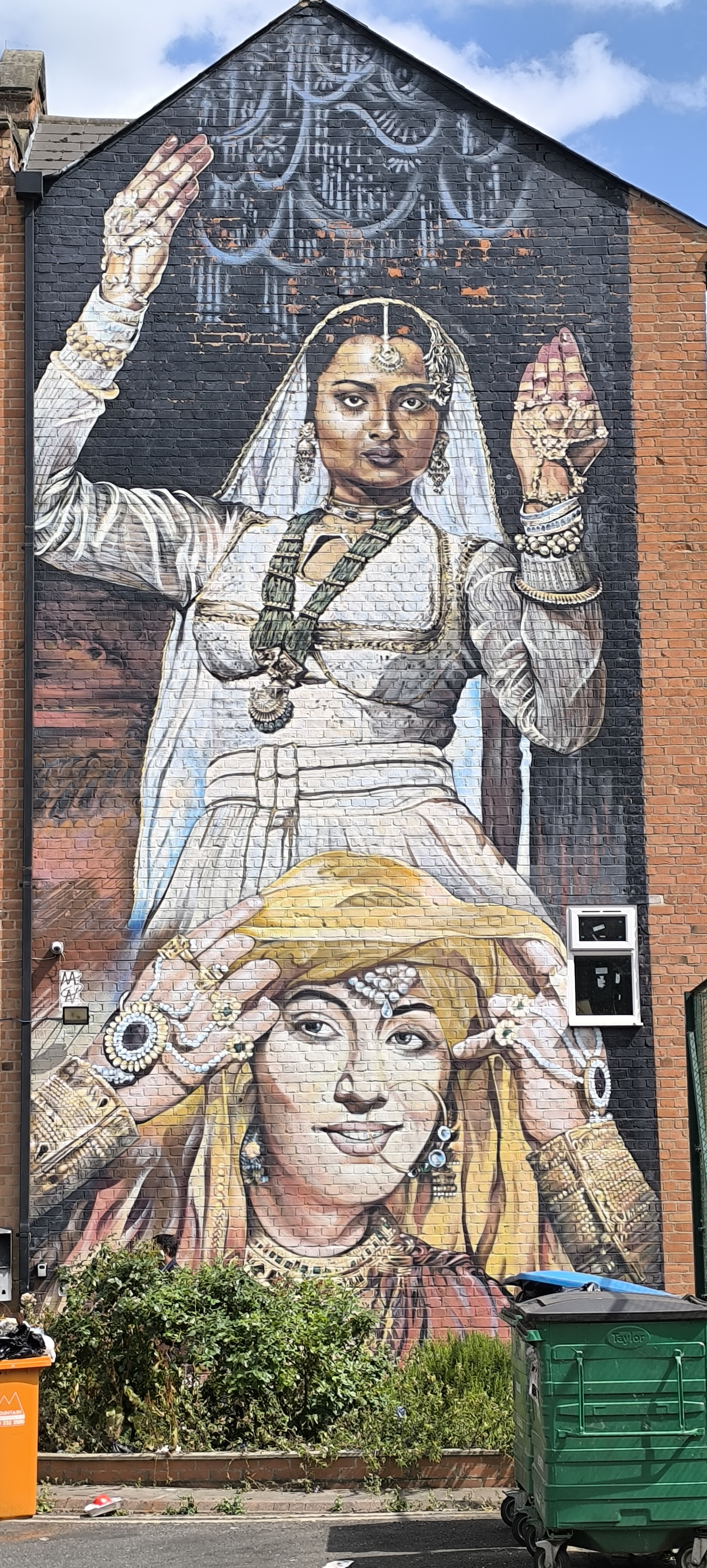
We turned back and crossed the dual carriageway. Along the way, I deliberately took a turn towards Garfield Street, where we had owned our first home. On the way, I noticed a mural painted across a two-storey wall showing two Bollywood stars. I had to stop and take a photograph. I also took a picture of the front door and the street sign. What surprised me most was how much had disappeared. The terraced houses on the opposite side had been demolished. The small factory at the end of my old street had gone, replaced by retirement homes.
We left Garfield Street and made our way back along Belgrave Road. I walked slowly, remembering a time when people I knew would stop to say hello, or when I could walk into a shop and chat to an owner I had known from the past. No one stopped me now. Many of the old shops no longer existed.
On Sunday, I spent the morning with my maternal cousin at his new house. Remembering the past is always nostalgic, and somehow enjoyable too. By the time we had had some tea and talked non-stop for an hour and a half, it was time to leave. I had arranged to meet someone I had not seen in a very long time.
A Friend From My First Days in Leicester
Barry was the first white man to show me the ropes when I started work at the factory in 1972. He respected me for who I was — an immigrant from Uganda who did not know how anything worked in this country. That meant more than I can easily say. Over the years, I taught him and his wife to make potato curry and puri. He calls me Bhai — the Gujarati word for brother. We share a love of heavy rock music and Indian food. He is retired now, mostly, shooting vermin on farms for a part-time living. He has a family and is a grandfather.
We met at the Woolpack pub, which I believe was his local. Apart from losing his hair and putting on a little weight, he was exactly as I remembered him. After a hug, we sat outside over a couple of beers and talked about the past, the present, and what life had brought us since those days. The curry and puri came up, of course. Forty-seven years had passed since we last sat together, and the hour we had felt far too short. Barely enough time to catch our breath.
That hour with Barry was the happiest moment of the whole trip. I am going back for more. Next time I will meet his wife and possibly his family too.
I had a coach to catch at 5.30 pm. Jitu picked me up, and after a short stop, he took me to St Margaret’s Bus Station. As I waited for the coach, I was not thinking about what I was leaving behind. I was thinking about what I might be coming back to.
Leicester has walking groups, parks with activities for older people, temples that serve the community in ways that go beyond worship, and a social life that simply does not exist where I live now. Most of all, it has Jitu. Coming back would bring me closer to my youngest sibling, the brother I walked to school in Kampala.
I am not certain yet. But standing at that bus station, I felt more sure than I have in a long time that Leicester is where my final chapter should begin.